We talk a great deal about what an ageing population costs. We talk rather less about what older people contribute. As the argument about pensions and intergenerational fairness heats up again, Sian argues that we should remember what today’s older people have already contributed through decades of work and taxation — and recognise the extraordinary amount they continue to contribute, often unpaid and largely uncounted, long after they have supposedly stopped working
I’ve been thinking a lot about ageism recently.
There is a debate raging through the media again about the triple-locked state pension. Whether the country can afford the triple lock is a completely legitimate question (it probably can’t). But much of the debate is being couched in terms of fairness. Why, we are asked, should pensioners have this generous protection when working-age adults don’t?
What seems to be largely missing is any acknowledgement that the vast majority of today’s pensioners worked for decades, contributing to the shaping of this country through their work, to its finances through their taxes and to their state pension through their National Insurance contributions.
And almost entirely absent is any acknowledgement of what retired people continue to contribute — to their communities, civic society and, indeed, the public sector itself — through volunteering, caring for grandchildren and others, donating money, sharing skills and simply getting on with the innumerable unpaid jobs that help keep society functioning.
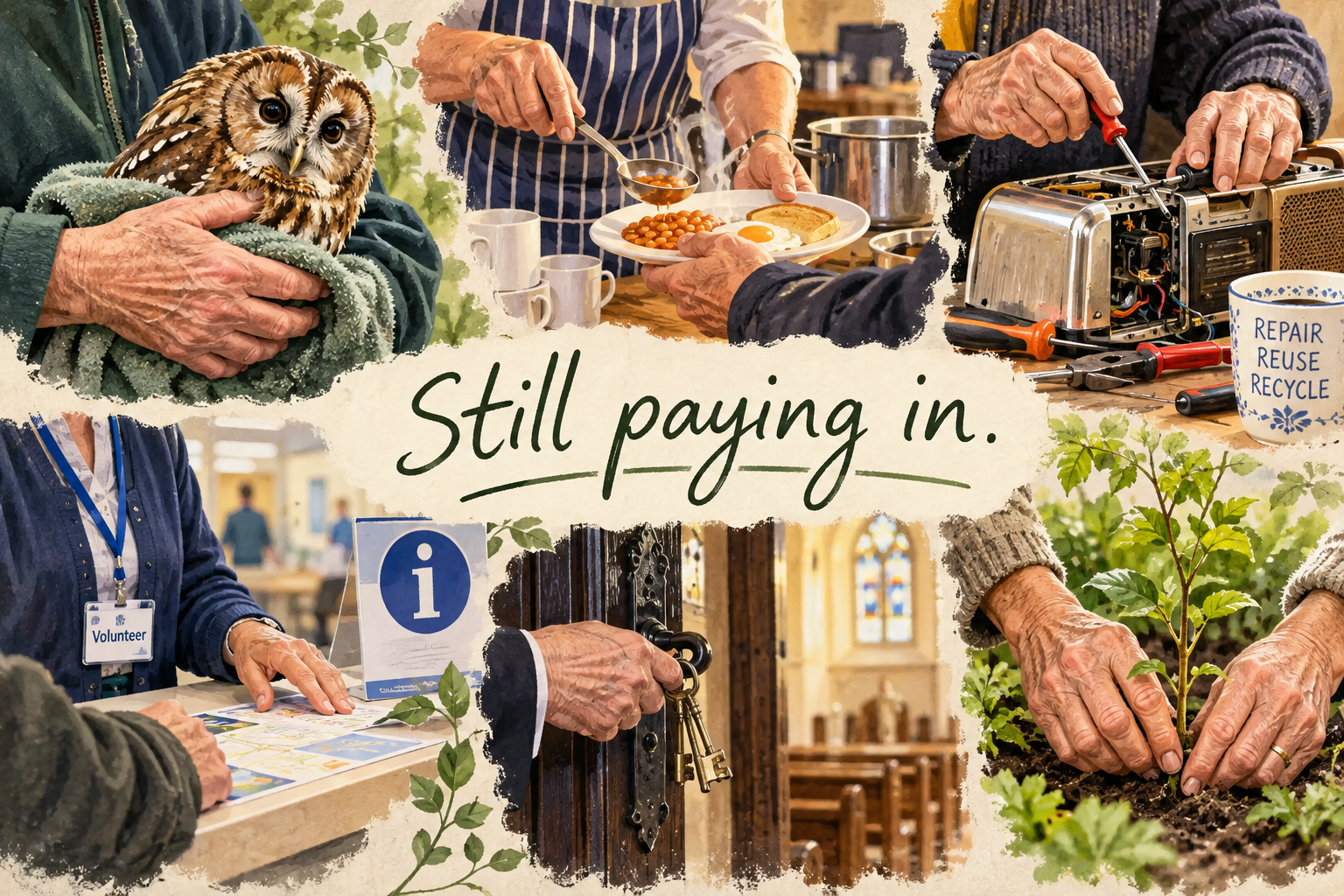
We met Vi* when we rescued a stunned and half-drowned tawny owl from our patio one morning.
Vi runs a local owl sanctuary and is the go-to person for local vets presented with injured owls. She set up her first aviary on her land thirty years ago, at the request of a local vet. She now has 21 aviaries which, when we visited, housed 87 owls of various species, as well as other injured birds and small mammals.
She funds the whole enterprise from her own money, cake and jam sales and occasional donations from people like us who see and value what she is doing. She has a small team of dedicated volunteers. All retired.
Vi herself is 82: a powerhouse of compassion and extraordinarily skilled at nursing and rehabilitating the birds and animals in her care.
Our own tawny owl was returned to us a couple of weeks later, strong and well, and we released her back into the woods around us.
Then there is Joan*. She is in her late 80s now, tiny and physically frail, but still able to cook a hot breakfast for 25 or so people who are sleeping rough or sofa-surfing. She is needle-witted and keeps volunteers and guests entertained with her views on current and local affairs.
Sue* is now 102.
At 17 she signed up to join the Auxiliary Territorial Service (ATS), the women’s branch of the British Army, and worked as a fitness training instructor and driver. In June 1945 she was sent to Bergen-Belsen, near Hanover in Germany, to help care for women and children who had been liberated from the camp.
She was recently honoured by our local town council for that work and given the Freedom of the Town in recognition of the “impossibly difficult work” she undertook there.
She still volunteers at her local church.
I’m a churchwarden at my local church, and the many, many activities we run to serve the wider community simply would not be possible without our army of retired volunteers.
Working-age people mostly can’t volunteer during the week because they are working. Parents of young children have even less spare time. And that’s OK. Because we know that, as people retire, many of them will take their turn — keeping the wheels of our activities turning and helping make our town a more resilient and compassionate place to live.
I see them everywhere.
The volunteers at our local hospital, helping in the café and at the information point, offering practical help and kindness to people who may be confused, frightened or simply lost.
The volunteers at our local repair café, sharing skills acquired over a lifetime to mend much-loved — and much-needed — household items for a donation.
The people sitting on hospital and charity boards. The people giving their time and money to political parties and local campaigns. The people raising money for community projects, running lunch clubs, visiting people who are lonely, driving people to appointments, keeping village halls open and community groups going.
Nearly all retired. Nearly all unpaid.
And none of this appears on a payslip or in GDP.
Perhaps that is part of the problem. We have become very good at measuring the economic cost of older people and rather less good at measuring their economic and social value.
So, of course, let’s have a debate about whether the country can afford the triple lock on the state pension. Let’s look at the numbers and make difficult choices if we need to.
But let’s not turn it into a crude contest about which generation is getting more than another.
And before we describe older people simply as a growing cost to be borne by younger generations, perhaps we should notice something else.
They haven’t stopped contributing. We’ve just stopped counting much of what they contribute.
*Names changed.